
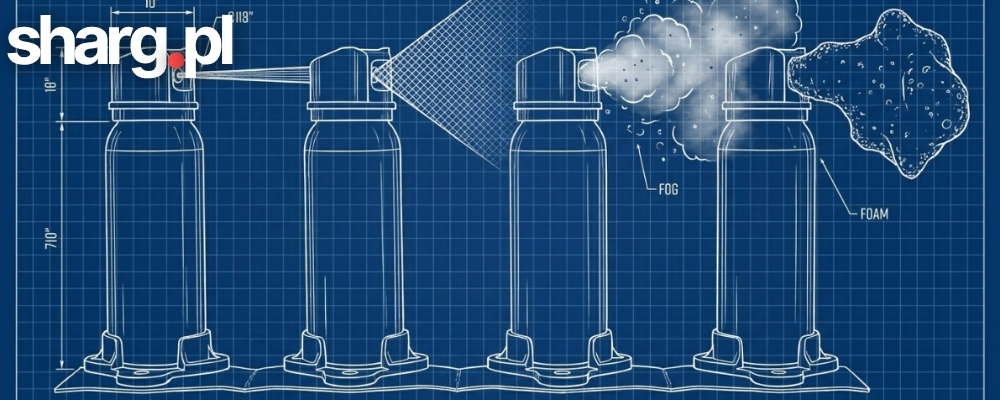
Key Takeaways from the Article
- The Stream nozzle creates a tight stream that provides greater precision and is less susceptible to crosswinds.
- The Cone or Fog nozzle sprays the agent in the form of a cone, making it easier to hit the target, but increasing the risk of contaminating the surroundings.
- The type of substance and the type of nozzle are two separate parameters – gel can be sprayed both as a stream and a cone.
- For indoors, it is better to choose a gel, foam, or tight stream rather than a fine mist.
- The declared range should always be checked in the specifications of the specific model.
What Exactly Do the Terms Stream, Cone, and Fog Mean?
Stream means a stream nozzle, while Cone and Fog refer to a conical or mist spray. These different solutions vary in the width of the covered area and the required aiming precision.
The Stream nozzle projects the agent in a narrow, focused stream. It allows you to direct the preparation at a specific point, limits its dispersion, and usually allows for use at a greater distance. However, the user must aim the canister more accurately.
Cone creates an expanding cone. It covers a larger area, so it does not require as much precision, but it is more susceptible to wind. Fog produces an even finer mist that can quickly cover the zone in front of the user. The boundary between the terms Cone and Fog is not always identically defined by all manufacturers, so you need to read the description of the specific product.
| Spray Type | Coverage Width | Aiming Precision | Wind Susceptibility | Application |
|---|---|---|---|---|
| Stream | small | high | lower | city, open space, longer distance |
| Cone | medium | moderate | higher | quick reaction, close and medium distance |
| Fog | large | low | high | open terrain, threats from multiple directions |
| Foam | small or medium | high | low | limiting environmental dispersion |
Stream or Cloud – Which Gives a Better Chance of a Successful Hit?
The stream is more precise, while the cloud covers a larger area. There is no single best solution for every user.
The "stream or cloud" dilemma should be resolved based on the conditions of use, not just the popularity of a given variant. A person moving mainly around the city may prefer a stream, as it reduces the risk of spraying the agent towards bystanders. An example is Sharg Graphite Gel 3 mln SHU Stream 50 ml, which has a declared effective range of 5 m.
A cone better tolerates inaccurate aiming of the canister. It can be useful in a dynamic event when the distance is closing rapidly. However, you must take into account the wind direction and the presence of other people – a wider area of effect also means a greater possibility of the user coming into contact with the sprayed substance.
When Does a Cloud Work Better Than a Tight Stream?
A cloud is useful when it is difficult to maintain precise aiming. Its advantage is the quick coverage of a larger space in front of the user.
A pepper spray cloud can be a reasonable choice in open terrain if the priority is a wide spray cone. This applies, among other things, to situations where the threat is moving quickly or there is more than one aggressor. This does not mean, however, that a mist always provides greater effectiveness – strong wind can change its direction of travel.
Before choosing, it is worth checking whether the Cone designation refers to a classic aerosol or a more concentrated substance. Sharg Defence Green Gel 2 mln SHU Cone 40 ml combines a gel formula with a cone nozzle, and its declared effective range is 4–5 m. This shows that "gel" is not automatically synonymous with a narrow stream.
Does Pepper Spray Gel Always Have a Stream Nozzle?
No, gel can be delivered both as a tight stream and in the form of a cone. Information about the spray pattern should be found in the product name or technical data.
Pepper spray gel contains a thickened carrier that reduces the dispersion of fine particles and makes it easier to control the direction of application. As a result, it can perform better in moderate winds and where it is important to limit contamination of the surroundings. However, it is still not completely immune to weather conditions or user error.
A good example of the difference between the formula and the nozzle is the Graphite series. Within it, there are Gel Stream and Gel Cone models, as well as foam with a stream delivery method. When purchasing, you must therefore separately compare:
- the form of the agent: aerosol, gel, or foam;
- the spray type: Stream, Cone, or Fog;
- the range declared by the manufacturer;
- the capacity and dimensions of the canister;
- the design of the safety head.
How Do Wind and Enclosed Spaces Affect the Choice of Nozzle?
Wind has the strongest effect on fine mist and a wide cone. Indoors, the dispersed substance can also affect the user and bystanders.
In an open space, you need to assess the direction of gusts before potential use. A stream or gel is usually easier to control than a light aerosol, but in a strong headwind, any variant can be deflected or partially blown back.
In a hallway, car, shop, or small room, a more reasonable choice will be an agent that limits the formation of an extensive mist. An alternative to gel is Sharg Graphite Foam 3 mln SHU Stream 50 ml. The foam is visible on the surface it adheres to, and the stream nozzle makes it easier to direct it to a specific point.
Good to Know
No application method completely eliminates the risk of contact with the irritant substance. Pepper spray should be treated as a means to stop the threat and retreat, not a tool for further confrontation.
How to Choose a Nozzle for Everyday Carry, Work, and Outdoor Use?
For everyday carry, a compact canister with a stream or gel is most often chosen. In security work and outdoors, capacity and the ability to execute a longer spray may be more important.
A 25–50 ml model is easier to fit in a pocket, purse, or dedicated holster. Canisters of 63 ml and larger offer a greater reserve of the agent, but require a comfortable and constantly accessible carrying method. Spray kept at the bottom of a backpack will not be useful, regardless of the nozzle parameters.
The outdoor variant must also be matched to the type of threat. Sharg Grizzly Gel 4 mln SHU Cone 63 ml is a product designed for protection against aggressive animals, not for use on humans. The cone nozzle provides a wide spray, while the manufacturer declares a range of up to 6 m.
What Mistakes to Avoid When Comparing Pepper Spray Nozzles?
The most common mistake is judging a product solely based on SHU or OC concentration. The parameters of the substance do not indicate how widely or how far it will be sprayed.
Before purchasing, it is worth eliminating a few typical mistakes:
- equating every gel with a stream nozzle;
- ignoring the declared effective range;
- choosing mist for a tight, enclosed space;
- carrying the canister in a hard-to-reach place;
- ignoring the expiration date and the condition of the head;
- leaving the spray in a hot car.
You should also not perform a test spray with a canister intended for defense. This can reduce the pressure or the amount of available agent. Separate training sprays without the irritant substance are used for learning the grip, disengaging the safety, and aiming the nozzle.
Frequently Asked Questions (FAQ)
Usually, a tight stream allows you to use a greater distance more effectively, but the range depends on the design of the specific canister. The binding value is the parameter provided by the manufacturer, not just the nozzle designation.
A cloud covers a wider area, so it requires less precision than a narrow stream. At the same time, it increases the risk of the agent being dispersed by the wind and contacting bystanders.
No. The thickened formula is usually less susceptible to gusts than a fine mist, but strong wind can still change the direction of the spray.
For the city, Stream, gel, or foam is often chosen because they make it easier to control the direction of application. The final decision should take into account the declared range, capacity, and carrying method.
After activating the canister, there is no certainty as to how much agent and pressure remains. For safety reasons, you should follow the manufacturer's instructions, and the safest solution is to replace the used unit.