
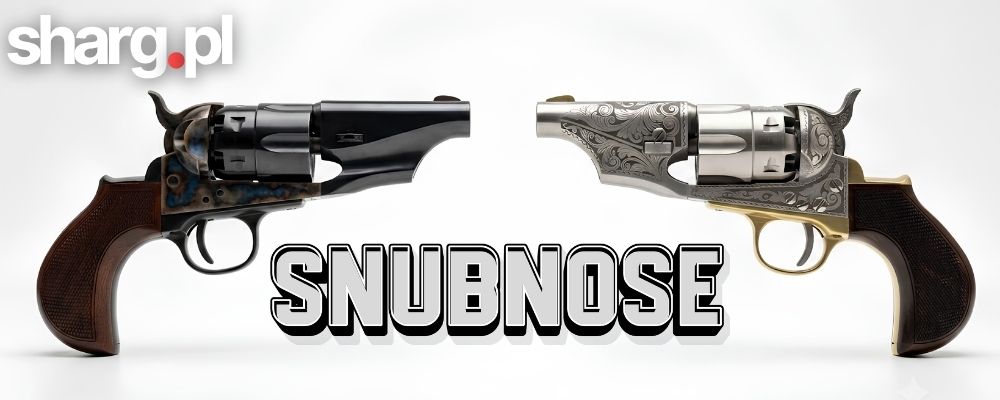
From Pocket Revolver to Pietta Snubnose - The History of Short-Barreled Black Powder Firearms
The Snubnose revolver is a design distinguished by its short barrel and compact dimensions. However, it is not one strictly defined firearm model. It is a type of revolver that evolved over decades: from mid-19th-century black powder pocket models, through compact cartridge revolvers, to 20th-century police designs.
Modern Pietta Snubnose black powder revolvers combine the mechanisms and silhouettes of historical Colt and Remington designs with the later concept of maximizing the weapon's compactness. Therefore, they should not be treated as copies of a single historical Snubnose. Rather, they are thoughtful variants inspired by several periods of revolver development.
The Snubnose Didn't Start With a Single Revolver
The history of firearms rarely unfolds according to a single, simple plan. Designers respond to specific user needs, and manufacturers modify earlier solutions, adapting them to new realities. This was also the case with the Snubnose revolver.
Long before this name appeared, there was a demand for a firearm smaller than heavy military revolvers. A full-sized model worked well in a cavalry holster but was inconvenient for someone looking for a handy personal defense weapon. The solution became pocket revolvers, followed by versions with increasingly shorter barrels.
Shortening the barrel alone did not yet create the modern Snubnose. Historical development also included shrinking the frame, changing the shape of the grip, limiting protruding elements, and adapting the design for easier concealed carry.
Therefore, the complete history of the Snubnose does not begin in the era of 20th-century police revolvers. Its first chapter should be sought in the days of black powder and percussion cap pocket models.
Colt 1849 Pocket - The Black Powder Ancestor of the Snubnose Idea
One of the most important points on the timeline of compact revolvers' development was the Colt Model 1849 Pocket. The model was introduced in 1848 and remained in production until 1872. Over 300,000 units were produced, making it one of Colt's most popular percussion designs.
The revolver was offered with four-, five-, and six-inch barrels, among others. Its small size made it much more suitable for carrying as a personal weapon than large military models. It wasn't called a Snubnose, but it executed the same basic idea: it was meant to be handy, easier to carry, and accessible when a full-sized revolver proved too heavy. Information regarding the production period, the number of units, and available barrel lengths is confirmed by the collections of the Metropolitan Museum of Art.
At this point, the first major difference between a historical pocket revolver and the later Snubnose emerges. The Colt 1849 Pocket was designed as a small firearm from the beginning. Many later short-barreled variants, however, were created by cutting down a larger model or using its mechanism in a more compact configuration.
Colt 1851 Navy - The Sleek Design That Defined an Era
The Colt Model 1851 Navy is one of the most recognizable percussion revolvers of the 19th century. The original design was a .36 caliber firearm with a barrel length of approximately 7.5 inches. Surviving examples confirm its characteristic open-top frame, octagonal barrel, and sleeker proportions compared to large military models.
The Model 1851 Navy was not a classic Snubnose. Its significance to the history of short-barreled revolvers stems from something else: it was a well-balanced, relatively lightweight, and extremely popular design. Because of this, it became a natural foundation for later shortened versions, Sheriff-type variants, and modern reinterpretations.
It is worth exercising caution when comparing an original Colt Navy with modern black powder revolvers. The historical Model 1851 was fundamentally associated with the .36 caliber and a long barrel. A modern variant inspired by its silhouette may feature a different caliber, barrel length, grip, or finish.
This does not mean such a design lacks a historical character. It retains the mechanical layout and lines of a classic Colt but interprets them in accordance with the later concept of a compact firearm.
Colt 1860 Army - A Full-Sized Military Firearm
The Colt Model 1860 Army represented the opposite end of the product lineup at the time. It was a six-shot, .44 caliber percussion revolver intended primarily for military applications. It was produced from 1860 to 1873, and the total number of units exceeded 200,000.
The Smithsonian Institution describes the Colt 1860 Army as the primary handgun used by Union troops during the American Civil War. It was a full-sized design, meant to be carried in a holster, not a compact pocket revolver.
So why does the Model 1860 Army appear in the Snubnose history? Its mechanism, large cylinder, and recognizable silhouette became the starting point for later shortened variants. Pairing a massive .44 caliber frame with a short barrel results in a firearm with entirely different proportions than the historical military model.
Such a revolver should be interpreted as a variation on the Colt 1860 Army theme, rather than a typical configuration issued to soldiers during the Civil War years. This is an important distinction, as modern trade names often combine the year of the historical original with solutions developed or popularized much later.
Colt 1862 Police - A Bridge Between Pocket and Military Models
The Colt Model 1862 Police was a lighter, .36 caliber percussion revolver. A surviving example in the Metropolitan Museum of Art's collection has an overall length of about 11 inches. The design was sleeker than the Colt 1860 Army and placed it closer to the personal defense weapon category.
For this reason, the Model 1862 Police is one of the most logical historical reference points for the black powder Snubnose. Its original form was still significantly longer than modern variants featuring a three-inch barrel, but its basic proportions better fit the idea of a compact revolver.
In the current Pietta catalog, the manufacturer lists a revolver described as an 1862 Police in .44 caliber with a 3-inch barrel, bearing the Snubnose name and a contoured grip referred to as the Thunderer. These specifications come directly from the brand's catalog, so they can be considered a confirmation of the modern configuration offered by Pietta.
However, this configuration is not identical to the original .36 caliber Colt 1862 Police. The modern model combines the historical percussion revolver mechanism with a larger caliber, a very short barrel, and a grip harkening back to the later era of cartridge firearms.
Remington 1858 and New Model Army - Why Names Can Be Misleading?
In the case of Remington revolvers, nomenclature requires special attention. The term "Remington 1858" is commonly used today for the entire family of closed-frame black powder revolvers. However, the actual Remington New Model Army appeared in its developed form in 1863.
The Smithsonian Institution points out that Remington developed the line starting with the Model 1861, and subsequently introduced the New Model Army in 1863. It was a six-shot .44 caliber revolver that became one of Colt's most significant competitors during the Civil War.
The year 1858 present in the names of modern replicas refers to an earlier stage of development and the patent lineage of Beals' design. This does not mean that every revolver labeled "1858 New Model Army" existed in precisely that form as early as 1858.
Remington's most distinguishing feature was its closed frame (solid frame). The top strap connected the front and rear parts of the structure over the cylinder. This set the Remington apart from the open-top frames of many percussion Colts and gave it an instantly recognizable silhouette.
The Pietta catalog features a modern 1858 New Model Army Snubnose in .44 caliber with a three-inch octagonal barrel, a steel frame, and a wooden grip. This variant can safely be described as a short-barreled interpretation of the New Model Army, since its name and specifications are provided directly by the manufacturer.
Compared to the full-sized model with an eight-inch barrel, the Snubnose version distinctly alters the design's proportions. Yet, it retains the closed frame, cylinder lines, and overall layout of the Remington. As a result, it remains easily identifiable, despite the radical shortening of the revolver's front end.
From Black Powder to Cartridge Revolvers
The second half of the 19th century brought a change that had a massive impact on handgun development. Percussion cap revolvers began yielding to designs utilizing self-contained metallic cartridges. A cartridge combining the projectile, propellant, and primer simplified operation and enabled the development of more compact models.
It was during the era of cartridge revolvers that a short barrel began to be perceived as a defining feature of a separate weapon category. It was no longer just about a scaled-down pocket revolver. Designs emerged where a compact silhouette, a rounded grip, and short length were the fundamental project assumptions.
Bulldog-Type Revolvers
One of the most important families were revolvers referred to as Bulldogs. Small models of this kind were manufactured in Great Britain, Belgium, the United States, and other countries. They came in many varieties, so over time, "Bulldog" became not only the name of a specific product but also a term for an entire group of compact revolvers.
A typical silhouette included a short barrel, a rounded grip, and a compact frame. Numerous surviving examples confirm that this category was developed by many manufacturers and encompassed both simple utility models and elaborately finished collector's pieces.
The Bulldog is a crucial link in the history of the Snubnose because it illustrates the moment when a short barrel ceased to be an accidental byproduct of miniaturization. It became a consciously chosen design feature.
Colt Model 1877 and the Origin of the Thunderer Name
In 1877, Colt introduced its first double-action revolver, the Model 1877. The design was offered in various calibers, and its variants came to be known by the names Lightning and Thunderer. Colt's official timeline confirms the year of introduction and the significance of the Model 1877 in the development of the brand's double-action revolvers.
Today, the name Thunderer is particularly relevant in the context of Pietta revolvers. It does not refer to an original percussion model from 1851, 1860, or 1862. Its historical lineage traces back to the later Colt Model 1877 cartridge revolver.
A characteristic, rounded grip profile is associated with the Thunderer model. The modern term "Thunderer grip" describes a handle inspired exactly by this shape. The National Firearms Museum materials indicate that the name for this profile originates from the grips used on the Colt 1877 Thunderer.
Thus, if a Pietta 1862 Police black powder revolver features a Thunderer grip, it combines elements from two different eras in one design. The mechanism and overall architecture reference Civil War-era percussion revolvers, while the grip shape nods to cartridge firearms introduced over a dozen years later.
This does not have to be a flaw or a historical error. It is a deliberate aesthetic reinterpretation. A problem would only arise if such a model were presented as a faithful copy of a single, mass-produced revolver from 1862.
Fitz Special - The Missing Link of the Modern Snubnose
By the early 20th century, the revolver was already a mature design. Manufacturers offered models with swing-out cylinders, double-action mechanisms, and self-contained ammunition. However, a demand for a firearm easier to carry discreetly still existed.
One of the most important figures of this period was John Henry FitzGerald, associated with the Colt company. Modifications created by him came to be known as Fitz Specials. They involved, among other things, shortening the barrel and reducing elements that could hinder the quick draw of the revolver.
This was not a single standard model produced on a mass scale. Rather, Fitz Special denoted a concept of modifications performed on the basis of existing revolvers. A documented example utilizing a Colt Police Positive was created before 1926.
The significance of this design lay in combining several features into one project. A short barrel, a more compact silhouette, and tailoring the revolver for a quick draw foreshadowed the modern Snubnose much more clearly than earlier pocket models.
Colt Detective Special - The Birth of the Modern Snubnose
In 1927, Colt introduced the Detective Special. It was a compact double-action revolver featuring a two-inch barrel, a six-round cylinder, and a design based on the Police Positive Special family.
The model was developed with plainclothes officers in mind, who needed a weapon easier to conceal than a full-sized duty revolver. That is exactly why the Detective Special is often considered the first modern, mass-produced Snubnose.
In this model, all the elements known from earlier history were combined into a cohesive whole:
- the short barrel wasn't an accidental modification,
- the frame was small enough for discreet carry,
- the double-action mechanism allowed firing a shot without manually cocking the hammer first,
- the swing-out cylinder facilitated the use of self-contained cartridges,
- the entire design was prepared as a mass-market product.
From that moment on, Snubnose became a recognizable category of revolver, not just a colloquial description of a short-barreled gun.
Smith & Wesson Chief’s Special - Solidifying the Category
Another crucial milestone was 1950, when Smith & Wesson introduced a small revolver that was named the Chief’s Special. The manufacturer notes that the design debuted during a police chiefs' conference and was designed primarily for plainclothes and off-duty officers.
The Chief’s Special helped solidify the image of the Snubnose that functions to this day: a small revolver, a short barrel, a rounded grip, and a clear purpose for easy carry.
Technically, the designs of this period were already very far removed from the percussion Colts and Remingtons. However, they were united by the same need that had earlier led to the creation of pocket revolvers: the user wanted a firearm smaller and more manageable than a full-sized model.
Where Does the Pietta Brand Appear in This History?
The history of F.lli Pietta began on March 22, 1963, when the Pietta Giuseppe company was founded to manufacture firearm components. In subsequent years, the enterprise developed its own production, and one of its most pivotal moments was establishing a collaboration related to recreating historical American models.
The manufacturer's official history describes a large order for 1851 Navy-style revolvers, which influenced the company's further direction. Over time, the offer also included Colt Army, Remington, Paterson, and Le Mat designs. Pietta became a brand strongly associated with reproducing firearms from the Civil War and the Wild West era.
The foundation of the brand's activity is recreating historical mechanisms and aesthetics. However, this does not mean that every Pietta revolver must be a faithful copy of one specific artifact located in a museum.
The manufacturer offers both models closely mirroring historical originals as well as variants with altered barrel lengths, frame materials, grips, and finishes. The Snubnose belongs primarily to this latter group.
What Really is the Black Powder Pietta Snubnose?
The Pietta Snubnose is a modern black powder revolver based on a historical design, but adapted to the aesthetics and proportions associated with later compact revolvers.
The most important historical elements include:
- a percussion cap ignition system,
- a muzzle-loading (front-loading) cylinder,
- a single-action mechanism,
- an open-top frame in Colt-inspired models or a solid closed frame in Remington-type designs,
- the overall lines of the frame and cylinder derived from 19th-century originals.
Elements of modern reinterpretation may include:
- a barrel shortened to approximately 3 inches,
- pairing a historical frame with a later type of grip,
- a caliber different from the best-known version of the original,
- decorative finishes and trade names,
- a combination of features that historically did not appear together in one mass-produced model.
The most accurate term is therefore a "historically inspired black powder variant." It allows one to appreciate the design connection to the original while not implying full compliance with a single antique specimen.
Two Confirmed Paths to the Black Powder Snubnose
Pietta 1858 New Model Army Snubnose
The variant based on the Remington retains the closed frame, octagonal barrel profile, and the massive silhouette of the New Model Army. The official Pietta catalog lists a .44 caliber, a steel frame, a wooden grip, and a 3-inch barrel length.
The full-sized New Model Army was a military revolver with a barrel of about eight inches. Shortening it to 3 inches radically changes the firearm's appearance, yet leaves the characteristic frame design intact. The result is a revolver whose historical origins are easy to recognize, even though its proportions are a modern variation.
Pietta 1862 Police Snubnose
The second design confirmed by the manufacturer's catalog utilizes the lines of the Colt 1862 Police. Pietta describes it as a .44 caliber model with a three-inch barrel, a steel frame, and a contoured Thunderer grip.
In this case, the blending of eras is even more pronounced. The historical Colt 1862 Police was a sleek, .36 caliber percussion revolver. The Pietta variant receives a larger caliber, a short barrel, and a grip harkening back to the Colt Model 1877.
Both designs showcase two distinct ways of interpreting the Snubnose idea. The Remington maintains a massive, closed frame, while the Colt offers a visually lighter silhouette with an open-top frame.
Colt or Remington - Two Different Schools of Design
The difference between a short-barreled Colt and a Remington doesn't just come down to appearance. Both families were created according to different design principles.
Colt's Open-Top Frame
In classic Colt percussion revolvers, there is no top strap over the cylinder connecting the front and rear of the frame. The barrel, cylinder, and main part of the frame form an arrangement characteristic of the Navy, Army, and Police models.
After shortening the barrel, such a design looks light and dynamic. The cylinder becomes a visually dominant element, and the revolver retains the easily recognizable Colt lines.
Remington's Closed Frame
In the Remington, a steel frame component runs over the cylinder. It gives the revolver a compact, unified silhouette. Even after shortening the barrel, the model retains a more massive appearance than its Colt-inspired counterpart.
Choosing one of these designs is therefore not just a decision regarding a specific model. It is a choice between the two most important schools of designing mid-19th-century American black powder revolvers.
Why Isn't Every Short Revolver a Snubnose?
In commercial parlance, category boundaries can be fluid. The terms Pocket, Sheriff, and Snubnose may be used for firearms with shorter barrels, but historically, they are not synonymous.
- The Pocket model was designed as a smaller pocket revolver.
- The term Sheriff is sometimes applied to shortened variants of Western revolvers, often still equipped with a barrel distinctly longer than a typical Snubnose.
- The Snubnose is primarily associated with a very short barrel and the compact silhouette of the entire firearm.
In the Pietta catalog, the difference is visible using the New Model Army as an example. The manufacturer lists a full-sized variant with an 8-inch barrel, a Sheriff version with a 5.5-inch barrel, and a Snubnose with a 3-inch barrel. These are three separate configurations based on the same design family.
Such naming organization helps avoid the oversimplification that every shortened revolver automatically becomes a Snubnose.
Most Common Myths About Black Powder Snubnoses
Myth: The Snubnose was a typical Civil War revolver
During the Civil War, pocket revolvers and models with shorter barrels were used, but the modern Snubnose category formed much later. The typical military designs were the full-sized Colt 1860 Army and the Remington New Model Army.
Myth: The Pietta Snubnose is a copy of a single antique model
Confirmed Pietta variants use historical mechanisms and silhouettes but combine them with three-inch barrels, altered calibers, or grips from a later era. It is more precise to describe them as modern reinterpretations.
Myth: The Thunderer name comes from the time of the Colt 1862 Police
The Thunderer is associated with the cartridge-firing Colt Model 1877. Using such a grip on a percussion 1862 Police model is a stylistic blending of two different periods of firearms history.
Myth: The Remington 1858 designation means the New Model Army was created in 1858
The year 1858 refers to earlier patent lineage and the entire family of designs. The Smithsonian dates the actual New Model Army to 1863.
Why is the Pietta Snubnose Interesting for a History Buff?
The greatest value of this design is not its perfect compliance with a single museum artifact. The Pietta Snubnose allows one to see how a classic black powder revolver changes upon the application of a concept developed in a later era.
It's a kind of historical design experiment. What happens to the silhouette of a military Remington after shortening the barrel to 3 inches? What will a sleek Colt Police look like with a grip inspired by the Thunderer model? Can a mid-19th-century mechanism adopt proportions associated with a 20th-century police revolver?
Such a juxtaposition also helps in better understanding the development of all handguns. It reveals a continuity of user needs:
- the revolver had to be lighter,
- it had to take up less space,
- it had to remain a multi-shot weapon,
- it had to be easier to carry than a military model.
Ignition systems, types of ammunition, mechanisms, and materials changed. Yet the need to possess a compact revolver itself remained constant.
The Full History of Snubnose in Brief
- In the mid-19th century, small percussion revolvers developed, the most prominent example being the Colt 1849 Pocket.
- Models like the Colt 1851 Navy, 1860 Army, 1862 Police, and the Remington New Model Army form the foundational design families of the black powder era.
- In the second half of the 19th century, Bulldog-type cartridge revolvers popularize a compact silhouette and a short barrel.
- The Colt Model 1877 introduces a grip shape later associated with the Thunderer name.
- Fitz Special modifications foreshadow a revolver tailored for discreet carry and a quick draw.
- The Colt Detective Special of 1927 establishes a mature template for the modern Snubnose.
- The Smith & Wesson Chief’s Special of 1950 solidifies the category's popularity.
- Pietta returns to percussion designs and creates modern variants combining a historical mechanism with a three-inch barrel and the later aesthetics of a compact revolver.
Snubnose as a Meeting of Several Eras
The history of the black powder Snubnose is not the history of a single firearm. It begins with the need to downsize the revolver, passes through percussion pocket models, military Colt and Remington designs, Bulldog revolvers, the Model 1877 Thunderer, the Fitz Special, and 20th-century police models.
The modern Pietta Snubnose encapsulates this history in a single design. Its mechanism hails from the black powder era, the short barrel references the later tradition of compact revolvers, and the selected grips and finishes draw from Wild West aesthetics.
It is not a faithful copy of a single historical model. It is a deliberate combination of solutions that, in the original history of firearms, appeared in different years and served different users.
That is precisely why the Pietta Snubnose can be interesting both as a black powder revolver and as a starting point for exploring nearly a hundred years of compact handgun development.
Frequently Asked Questions About Pietta Snubnose Black Powder Revolvers
A Snubnose revolver is a revolver with a very short barrel and a compact silhouette. The term does not denote one specific model or manufacturer. It most often refers to designs with a barrel length of about 3 inches or shorter. In the case of Pietta revolvers, the name Snubnose describes modern, short-barreled variants of designs inspired by historical Colt and Remington revolvers.
The name Snubnose signifies a revolver with a distinctly shortened barrel. The English term refers to the short, seemingly "snubbed" front of the firearm. In Pietta's catalogs and product names, the term Snubnose helps distinguish variants with roughly 3-inch barrels from full-sized revolvers and longer variations designated, among others, as Sheriff.
No, the Pietta Snubnose black powder revolvers described in the article do not require a firearms permit in Poland. They are replicas of separate-loading firearms, the historical originals of which were created prior to 1885. According to Article 11, point 10 of the Weapons and Ammunition Act, possessing such a firearm and its replicas does not require a permit.
However, the lack of an obligation to obtain a permit does not mean a black powder revolver is a toy or an object devoid of legal restrictions. Before purchasing, you should check current regulations and the conditions of sale for the specific product. The current text of the act can be found in the Internet System of Legal Acts (ISAP).
No, a Pietta black powder revolver, being a replica of a separate-loading firearm from before 1885, is not subject to mandatory registration. Article 13, paragraph 1 of the Weapons and Ammunition Act exempts the firearms listed in Article 11, point 10 from the registration requirement. This applies to models meeting the statutory conditions set out for this category of firearms.
Yes, the Pietta Snubnose is a separate-loading firearm. The lack of a permit requirement does not change its nature or potential danger. A black powder revolver must be stored, carried, and used responsibly, in a manner that prevents access by unauthorized persons.
You should shoot a black powder revolver at a legally operating shooting range and in accordance with its regulations. The Weapons and Ammunition Act stipulates that firearms may be used for sports and training purposes only at shooting ranges. Not needing a permit does not mean you have the right to shoot anywhere you please.
In the 19th century, small black powder revolvers and examples with short barrels existed, but they did not yet form the modern Snubnose category. Terms like Pocket, Sheriff, or specific model names were primarily used. Today's Pietta Snubnose utilizes the mechanism of a historical percussion revolver, but its proportions also allude to the later development of compact handguns.
Not always. The Pietta Snubnose is a historically inspired variant that combines the mechanism and silhouette of a 19th-century revolver with a short barrel and stylistic elements sometimes derived from a later period. Such a model should not automatically be presented as an exact copy of a single specimen used during the Civil War.
One of the most important black powder ancestors of the Snubnose was the Colt Model 1849 Pocket. It was a small percussion revolver designed for more comfortable carry than large military models. Later, the development of compact firearms was continued by Bulldog-type revolvers, Fitz Special modifications, and the mass-produced Colt Detective Special of 1927.
The main difference lies in the frame design. Pietta revolvers inspired by the Colt Navy, Army, or Police feature a characteristic open-top frame without a top strap over the cylinder. The Pietta Remington 1858 New Model Army Snubnose has a closed (solid) frame, the top part of which runs over the cylinder.
Because of this, the Colt Snubnose looks sleeker and exposes the cylinder more strongly. The Remington Snubnose has a more compact and massive silhouette. Both variants represent two distinct schools of 19th-century black powder revolver construction.
The name Thunderer refers to a grip shape inspired by the later Colt Model 1877 revolver. The historical Colt 1862 Police was a percussion revolver, whereas the Colt 1877 Thunderer was a cartridge revolver introduced over a dozen years later. Pietta thus combines a black powder design with a grip nodding to a different era in a single model.
The name Thunderer was used for a variant of the Colt Model 1877 revolver chambered in .41 caliber. The Model 1877 was among the first double-action revolvers produced by Colt. The name does not originate from the era of the Colt 1851 Navy, 1860 Army, or 1862 Police revolvers, hence its application to a modern percussion model serves as a stylistic nod.
The name Remington 1858 refers to the earlier patent lineage and the entire family of designs developed by the Remington company. The actual New Model Army appeared in its developed form in 1863. The term "1858 New Model Army" is currently a common trade name for replicas, but it does not represent the precise introduction date of the final military model.
No, the terms Sheriff and Snubnose are not exact synonyms. The Sheriff variant is a shortened version of a full-sized revolver, but it may still have a barrel distinctly longer than a typical Snubnose. The name Snubnose is most commonly applied to the most compact variants with a barrel of about 3 inches or less.
Many Pietta revolvers designated by the manufacturer as Snubnose feature a barrel length of approximately 3 inches. However, this parameter should always be verified on the specific product's page, as the manufacturer's offer includes various design families, finishes, and configurations. The Snubnose name itself primarily indicates the short-barreled nature of the revolver.
No, the Pietta Snubnose black powder revolvers described are separate-loading designs. They do not utilize typical modern self-contained metallic cartridges. They refer back to historical percussion cap revolvers, in which the individual elements needed to fire a shot do not constitute one ready-made cartridge.
Yes, F.lli Pietta is an Italian manufacturer involved in producing historical firearm reproductions. The company began operations in 1963, and one of its most important areas became revolvers inspired by Colt, Remington, and other 19th-century models. Pietta manufactures both classic replicas and modern variants, such as the Snubnose.
The choice between a Pietta Colt Snubnose and a Pietta Remington Snubnose primarily depends on preferred design and aesthetics. The Colt has an open-top frame and a sleeker line. The Remington has a closed frame and a more compact silhouette. Before purchasing, one should compare the exact specifications, frame material, grip profile, and the description of the specific variant.
Current models of Pietta Snubnose black powder revolvers can be checked in the search results of the Sharg.pl store. The availability of individual variants may change, so detailed data should always be verified on the current product page.
Check Out Pietta Snubnose Black Powder Revolvers
Currently available models, finish variants, and detailed technical specifications can be found in the Sharg.pl offer. Before choosing a specific revolver, it's worth comparing Colt's open-top frame design with Remington's closed frame and checking the information provided on the selected product's page.
Prepared by: Sharg.pl - direct importer and distributor of the world's best brands