History of Glock knives - from the military FM78 to the survival FM81
The history of Glock knives began before the creation of the pistols with which the brand is associated worldwide today. In the 1970s, the company developed the FM78 field knife for the military. In 1981, the design was expanded to create the FM81, featuring a saw on the back of the blade. Both models retained a simple construction, spring steel, a polymer handle, and a characteristic sheath.
Before Glock became famous for pistols
The Glock company was founded in 1963 in Deutsch-Wagram, Austria. In its early days, it manufactured various products from wood, metal, and plastic. The experience gained in metalworking and polymer molding proved particularly important, as it later became the foundation for the company's military projects.
In the mid-1970s, the company began producing its first items intended for the armed forces. These included components for practice and fragmentation grenades, machine gun belt links, and field knives designated as the FM78. It was only at the beginning of the following decade that the company started working on the P80 pistol.
This means that the military knife was one of the products that paved the way for Glock to secure large orders for the Austrian armed forces. The experience gathered during its production involved not only steel processing but also the design of durable polymer components and the organization of mass production.
Why did the Austrian army need a new field knife?
In the second half of the 1970s, the Austrian armed forces were modernizing their soldiers' equipment. Part of this process included the introduction of the StG 77 rifle, more widely known as the Steyr AUG, and the search for a new, multi-purpose field knife.
In 1976, a procedure was initiated for a design that was supposed to combine the function of a durable field tool with military equipment requirements. The knife had to be lightweight, resistant to heavy use, simple to produce, and comfortable to carry alongside other gear.
The Jagdkommando, a special unit of the Austrian Bundesheer, participated in drafting the requirements. Their field experience influenced the emphasis placed on balance, structural durability, and the ability to perform a variety of outdoor tasks. The history of this project has been described, among other places, in specialized literature dedicated to the Jagdkommando and Austrian military equipment.
The result was not an elegant parade knife or a complicated multi-tool. A design subordinated to pure simplicity was created: a fixed blade, an injection-molded handle, a lightweight sheath, and a minimum number of elements that could loosen or fail.
The birth of the Glock Feldmesser 78
In 1978, the Austrian Bundesheer introduced the Feldmesser 78 into its equipment. The abbreviation FM comes from the German word Feldmesser (field knife), while the number 78 indicates the year the model was adopted. This information is confirmed both by the knife's service history and its 40th anniversary celebrated in 2018.

The FM78 measures 290 mm in overall length, of which 165 mm is the blade, measuring 5 mm in thickness. The knife itself weighs 206 g. These proportions allowed for the creation of a tool large enough for field work, yet lightweight compared to many military knives designed for similar purposes.
The blade is made of spring steel hardened to approximately 55 HRC. Modern pieces receive an electrophoretic coating that limits metal contact with moisture and increases the surface's resistance to wear.
The moderate hardness is no accident. In a military knife, it's not just about holding an edge for a long time, but also about resistance to impact, stress, and working at varying angles. Spring steel is well suited for this purpose, and the cutting edge can be relatively easily touched up using simple sharpening equipment.
The FM78 design stemmed from military requirements
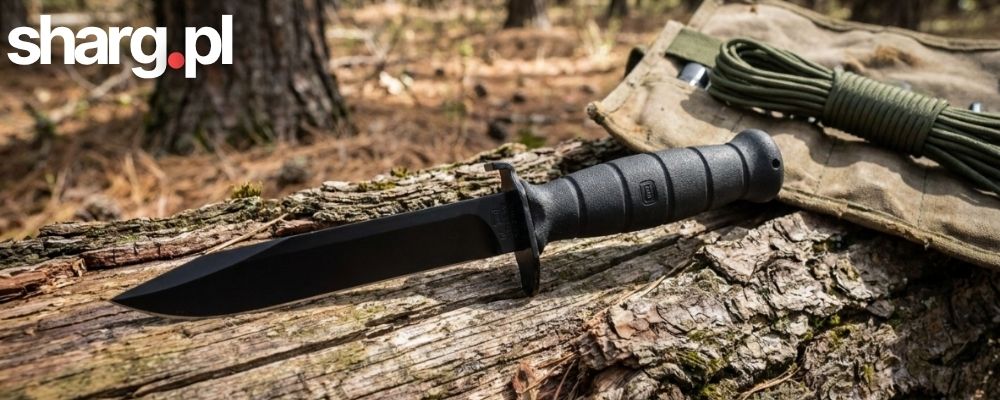
At first glance, the Glock FM78 looks very minimalist. It's hard to find any element in its construction that serves a purely decorative function. Every part has been subordinated to durability, easy production, and comfortable handling.
Fixed blade with a utilitarian profile
The blade has a clearly defined tip and a smooth cutting edge. Its thickness allows for more demanding field work, while the tapering profile makes precise cutting and whittling easier.
A characteristic part of the crossguard is bent at a right angle. This solution provided the necessary clearance when mounting the knife on the appropriate StG 77 rifle attachment, while also allowing the crossguard to be used as a bottle opener. To this day, the manufacturer points out opening bottles and ammunition crates as example uses for the FM78.
Polymer handle
The handle is made of injection-molded plastic. Transverse grooves improve control over the knife, and the lack of separate grip scales reduces the number of screws, rivets, and mechanical joints.
At the end of the handle, there is a lanyard hole and a removable polymer cap. Beneath it is a socket allowing the knife to be mounted on the dedicated StG 77 rifle attachment. However, the Bundesheer treated the FM78 primarily as a multi-purpose field knife, rather than a standard bayonet.
Sheath without metal springs
One of the most ingenious elements of the design is the polymer sheath. It was molded as a compact structure in which the flexibility of the plastic replaces additional springs and complicated latches.
A movable catch locks the handle in place, securing the knife against accidental slipping out. To remove the FM78, simply push back the catch and pull the handle. The sheath also features a belt loop and a drainage hole for water and debris.
This is a prime example of Glock's design philosophy: instead of adding more parts, the properties of the material itself were utilized. As a result, the sheath remains lightweight, durable, and easy to clean.
The FM78 in the Austrian Bundesheer manual
The Feldmesser 78 quickly became a fully-fledged piece of equipment, rather than just an extra tool issued without a specific role. In February 1979, the Austrian Ministry of Defense published a training manual titled "Das Feldmesser 78". The existence of this manual is confirmed by preserved archival copies.
The document presented the FM78 as a multi-purpose knife designed for daily use in field service and for applications intended in military training. It covered how to carry it, how to handle the knife, and its place in a soldier's gear.
The manual shows that the FM78 was not designed solely as a single-task blade. It was meant to accompany the soldier during regular field tasks, preparing positions, opening packages, and other activities performed outside the barracks.
In 2018, a specialized study on Austrian military equipment reported that the FM78 was still being used during daily field service and in Bundesheer training. Forty years after its introduction, the design still fulfilled its original function.
Glock FM81 - evolution through the addition of a saw
In 1981, Glock introduced a development of its field knife. The model received the designation FM81 and retained the basic FM78 design, but a sturdy saw was added to the back of the blade. This was the most important change in the history of the entire Glock knife family.

The FM81 maintained an overall length of 290 mm, a 165 mm blade, a polymer handle, and a sheath with the characteristic latch. The manufacturer lists the weight of the knife itself at 202 g.
The saw increases the tool's capabilities when working with wood, plastics, and other materials encountered in the field. It doesn't replace a full-sized folding saw, but it allows for making notches and performing tasks for which the smooth spine of the FM78 was not intended.
The manufacturer currently designates the FM78 as a Field Knife, while the FM81 is classified as a Survival Knife. These names accurately reflect the difference between the models. The FM78 remains a simpler tool with a smooth spine, while the FM81 expands its capabilities with an additional outdoor function.
FM78 and FM81 - two versions of the same philosophy
The FM81 did not replace the FM78 model. Both knives are still offered because they respond to different user needs.
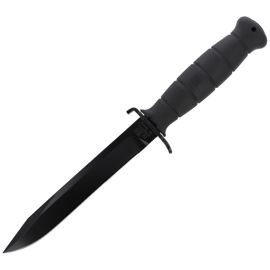
Glock FM78
- features a smooth blade spine;
- weighs 206 g;
- is a classic field knife;
- has a simpler blade surface to clean;
- performs perfectly as a basic outdoor tool.
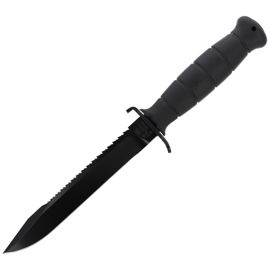
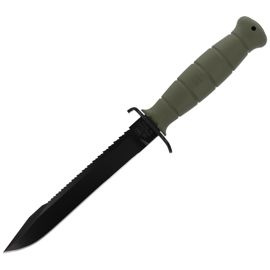
Glock FM81
- features a saw on the blade spine;
- weighs 202 g;
- is classified as a survival knife;
- allows for making additional notches in wood and plastics;
- retains the handle and sheath known from the FM78.
The choice between them doesn't come down to picking the "better" model. The Glock FM78 Field Knife Black will be suitable for a user who prefers the simplest blade possible. The Glock FM81 Survival Knife Olive offers an additional saw, useful during some camp and field tasks.
Why has the design of Glock knives barely changed?
Comparing early FM78 examples with modern production reveals very few changes. Over time, the markings, surface finish methods, and available colors changed, but the fundamental layout of the blade, handle, and sheath remained the same.
On the oldest examples, you can see the manufacturer's circular logo. Later, it was replaced by the distinctive, angular emblem known from current Glock products. The change in the logo is often one of the first elements that allow you to distinguish an early military knife from a later commercial piece.
The lack of subsequent generations does not indicate a halt in development. The FM78 was intended from the start to be a simple, mass-produced tool with a small number of parts. Increasing the complexity of the design would have weakened one of its greatest advantages.
That is exactly why a knife designed in the 1970s does not look like a museum exhibit today. Its form is austere, yet still practical: a wide blade, a stable handle, a secure lock in the sheath, and a weight that allows for comfortable carry.
40th Anniversary of the FM78 and the 780-piece limited series
In 2018, Glock celebrated the fortieth anniversary of the FM78. For this occasion, a limited series of exactly 780 field knives was prepared. The number of pieces directly referenced the model's designation.
The anniversary knives were placed in silver, polymer cases with custom-fitted interiors. Each piece included a certificate confirming its authenticity. This was not an attempt to modernize the FM78, but rather a way to emphasize the importance of the original design in the brand's history.
The jubilee also shows that the knife did not remain in the shadow of the later pistols. For the manufacturer, the FM78 is an important symbol of the period when the small company was gaining experience in fulfilling military requirements and producing durable goods from metal and polymer.
From military equipment to modern outdoor use
The military origins of the FM78 and FM81 are a significant part of their history, but today these knives also end up in the hands of tourists, survival enthusiasts, outdoor gear users, and collectors.
The fixed blade can be used for preparing kindling, whittling wood, cutting ropes, opening packages, and performing simple camp chores. The polymer sheath protects the knife during transport and allows it to be attached to a belt or other gear.
In such applications, simplicity remains particularly important. There is no folding mechanism, blade lock, or moving parts requiring regular adjustment. After finishing work, the knife simply needs to be cleaned, dried, and its blade surface protected.
FM78 with a fire starter as a simple field kit
The history of the FM78 shows that good field gear doesn't have to be complicated. The same principle can be applied when assembling modern outdoor equipment.
A knife and a fire starter create a basic kit that allows you to prepare material for kindling and get a spark without using batteries. The FM78 enables wood processing, and the fire starter complements its capabilities with the element needed to start a fire.
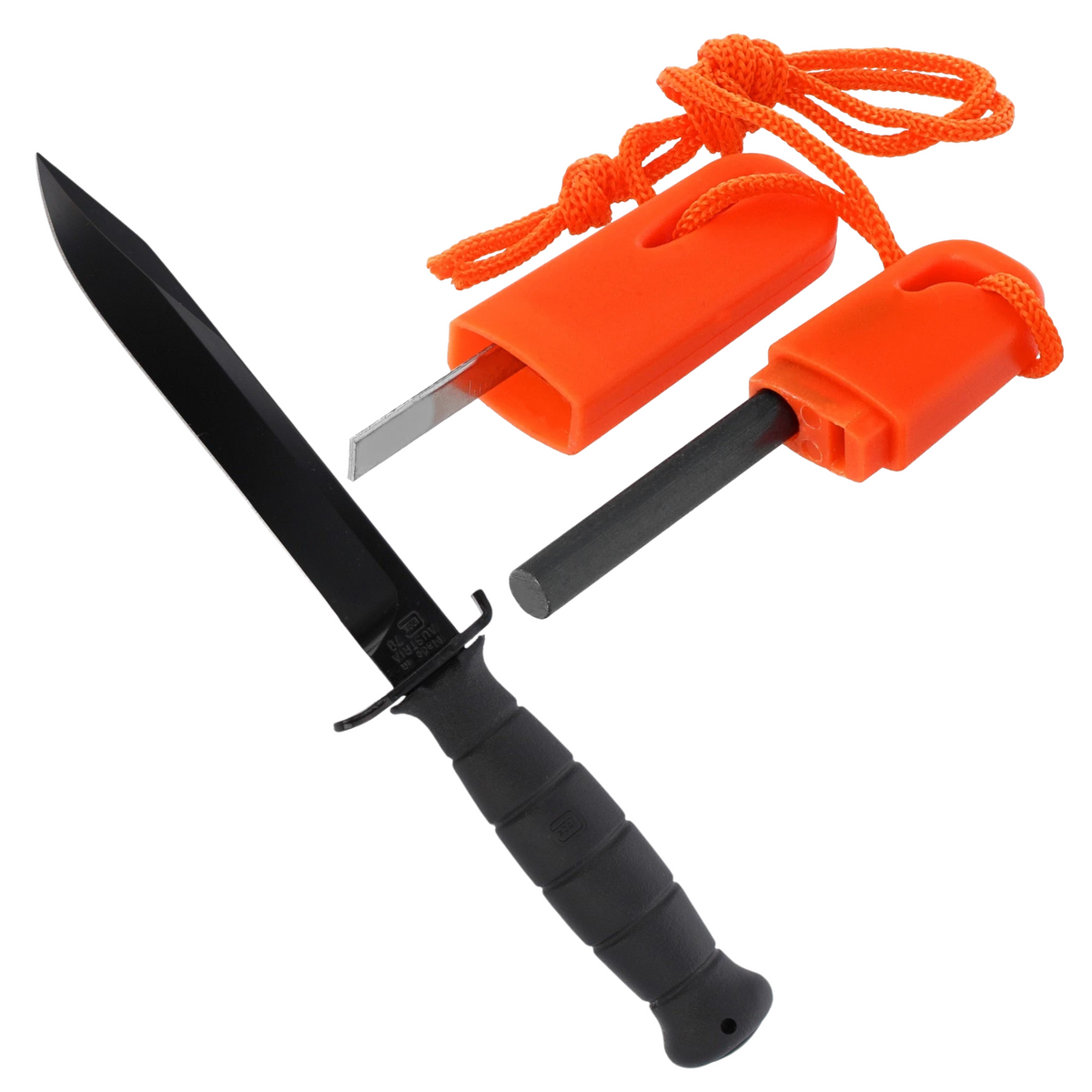
The Glock FM78 kit with a fire starter combines two fundamental pieces of equipment useful during a camping trip, expedition, or when putting together an emergency kit.
The legacy of Glock knives
The history of Glock knives is a story of a design that was born from specific military requirements and has not lost its utilitarian character over the decades.
The FM78 gave the company experience in military design, mass steel processing, and using polymer to produce durable components. Three years after the introduction of the first model, the FM81 appeared, evolving the proven design by adding a saw.
The greatest strength of both knives is not the number of functions. It is consistency. The spring steel blade, hardness of about 55 HRC, simple handle, and ingenious sheath create a set of features that met the army's requirements in 1978 and still finds application in the field today.
It is one of the few military products of its era that remains available in a form so close to the original design. Because of this, the FM78 and FM81 are not just tools, but also a tangible piece of the Glock brand's history.
FAQ - which Glock survival knife to choose?
To start with, it's worth choosing a fixed-blade knife with a matching sheath. The Glock FM78 will be suitable for someone opting for a simple design without a saw, and the Glock FM81 for a user who wants an additional saw on the back of the blade.
Yes, if you need a simple, full-sized field knife with a fixed blade. Glock knives combine spring steel, a polymer handle, and a lightweight sheath, making them perform well as a basic outdoor tool and part of a survival kit.
Choose the Glock FM78 if you care about a classic field knife with a smooth spine. Choose the Glock FM81 when you need a survival knife with a saw for additional field tasks. The saw is the most important difference between these models.
The Glock FM81 Survival Knife is intended for people looking for a survival knife with a saw. The saw is located on the back of the blade, leaving the main cutting edge available for cutting, whittling, and preparing materials in the field.
The Glock FM78 Field Knife is a field knife without a saw, featuring a smooth blade spine. It is a good choice for a user who expects the simplest possible design and does not need extra teeth.
Yes. A Glock military knife can also serve as an outdoor knife for camping, hiking, and field work. The FM78 provides a simple blade for basic tasks, while the FM81 expands the knife's capabilities with a saw.
Both models are suitable for carrying in a survival backpack. The Glock FM78 weighs 206 g, and the Glock FM81 weighs 202 g, so the weight difference shouldn't dictate your choice. The most important factor is whether you need a saw on the back of the blade.
No. The saw on the spine of the Glock FM81 is an auxiliary tool for notching and processing smaller elements. It increases the functionality of the survival knife, but it does not replace a full-sized folding saw when cutting thicker branches.
The catalog number 12161 designates the black Glock FM78 Field Knife Black. It is a classic field knife with a fixed blade and a smooth spine, supplied with a polymer sheath.
The catalog number 12029 designates the olive Glock FM81 Survival Knife Olive. This model has a fixed blade and a characteristic saw located on its spine.
The Glock FM78 has a smooth blade spine, while the Glock FM81 has a distinct saw. Both knives feature the GLOCK marking on the handle, whereas the number 78 or 81 is located at the base of the blade, right next to the handle.
The blades of the Glock FM78 and FM81 are made of spring steel hardened to approximately 55 HRC. The blade surface is protected by an electrophoretic coating, and the handle and sheath are made of polymer.
Yes. A hardness of about 55 HRC is tailored to the character of a field and survival knife. It provides the blade with the resilience needed during field work, while simultaneously making it easier to restore the edge without specialized equipment.
Yes. The Glock FM78 and FM81 are offered with a custom-fitted polymer sheath. The sheath protects the blade during transport and allows the knife to be carried as part of field gear.
Yes. The kit combines a fixed-blade knife with an independent spark source. The Glock FM78 can be used to cut and prepare kindling material, and the fire starter allows you to start a fire without batteries.
Yes. GLOCK began producing its first military goods, including the FM78 knife, in the 1970s. The FM78 dates back to 1978, which the manufacturer confirmed by celebrating the model's fortieth anniversary in 2018. Work on the P80 pistol began later, in the early 1980s.
At Sharg.pl, you can find the Glock FM78 Field Knife Black 12161, Glock FM81 Survival Knife Olive 12029, and the FM78 kit with a fire starter.
Glock knives in the Sharg.pl offer
At Sharg.pl, genuine Glock knives are available for users looking for durable field, survival, and collector's equipment.
Prepared by: Sharg.pl - direct importer and distributor of the world's best brands