
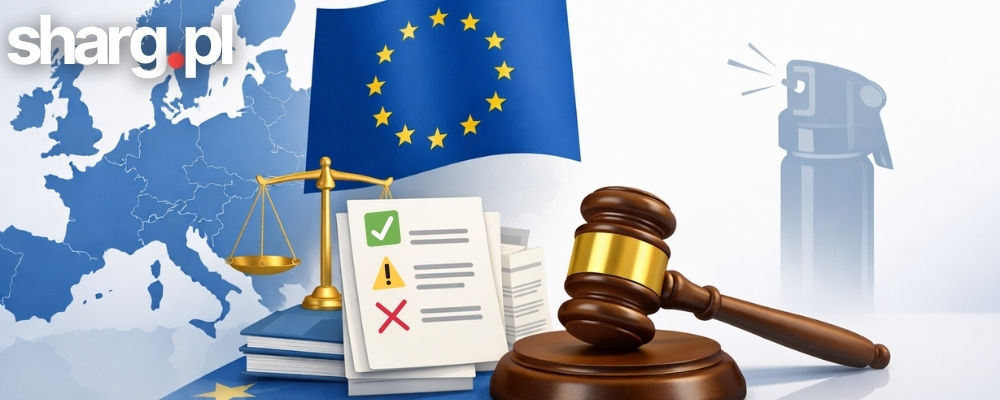
Pepper Spray in the EU 2026 – Where Legal, Where Banned, Where Only Restricted?
In the European Union in 2026, there is still no single common rule regarding pepper spray (OC). Each member state sets its own regulations on possession, carrying, and use. This article helps you quickly get oriented and points you to where to find details + official sources.
Remember: even if pepper spray is legal in your destination country, transiting through a country with a ban or very strict rules often ends in confiscation and trouble.
In Which EU Countries Can You Legally Carry Pepper Spray?
In 2026, the situation is that pepper spray (OC) is legal in most EU countries, but with catches – from total bans to requirements like certifications or concentration limits. That's why we've created this simple division into three groups so you can quickly check if your pepper spray will clear borders without issues.
Possession, carrying, and transport are prohibited for civilians – even in luggage. This applies to Belgium, Netherlands, Ireland, among others.
The most common situation – legality depends on OC concentration, specific model, age, and sometimes even whether you carry it only at home.
You can buy and carry (usually from age 18), but always only for necessary self-defense + bans in certain locations (airports, stadiums, etc.).
Full, up-to-date division + official sources and exact regulations are in the articles below.
Three Main Groups – Which Case Applies to Your Country?
Pepper spray is treated as a weapon – possession and transport are prohibited, even in transit. Very high risk of confiscation.
Most EU countries. Usually several conditions must be met: appropriate OC concentration, certification, specific model, sometimes registration or carry only at home.
You can buy and carry it on you (usually from age 18), but always within necessary self-defense and with bans in many public places.
This article is a starting point. The most accurate and current information (as of January 2026) is always in the dedicated articles above – they include links to laws and authorities.
Full List of EU Countries – Where You Can, Where Better to Leave Pepper Spray at Home
Click a country name – it will take you to the detailed description and current regulations on the relevant subpage (as of January 2026).
Click a country to go to details and official sources on the relevant subpage.
Most Common Mistakes and Traps for Poles Traveling in the EU with Pepper Spray
- Transit through a banned country – even a few-hour stop can end in confiscation.
- Storing in the car – in many countries this is still a “public place” if the spray is easily accessible.
- Difference between possession and carrying – in conditional countries, often only home storage is legal.
- Airports and airplanes – regardless of country, pepper spray is banned in carry-on (and often checked) luggage.
- Controlled locations – stadiums, concerts, offices, metro – own regulations prohibit bringing it in.
Frequently Asked Questions (FAQ)
No. The EU has no single “European” legality for pepper spray – each country regulates it independently. That's why the guide divides countries into three groups: banned countries (❌), conditional countries (⚠️), and generally permitted countries (✅).
Fastest: check the lists on the 3 subpages and go to the country's card. If planning travel through multiple countries, verify every country along the route, as transit can be more important than the destination.
Often no. In practice, the rules of the country where you currently are (even “just passing through”) apply. If transit goes through a banned or strictly conditional country, risk of inspection, item seizure, and consequences increases.
Before the trip, check especially: ❌ banned and ⚠️ conditional.
Not always. In many countries, transport in a vehicle is treated similarly to possession in public space – especially if the spray is readily accessible. Even in “✅” countries, issues can arise at controlled locations (ferries, borders, mass events) and transit through “❌/⚠️” states.
No. Possession and use are two different matters. Even if legal, use is usually subject to general rules (e.g., necessary defense, proportionality, real threat). Being allowed to have it does not mean you can use it in any situation.
Not always. Many regulations concern specific categories of irritants, and differences between OC (capsaicin) and other substances can matter legally. In conditional countries, most often classification, parameters, or product approval count: see the list (⚠️).
Yes — most common are age limits, bans in protected facilities (offices, courts, stadiums), mass events, and sometimes product identifiability as OC. So even with “✅”, read the specific country card and official source.
List of “✅”: countries where pepper spray is permitted.
Yes. In some countries you can buy pepper spray, but carrying or transport in public space is restricted (e.g., “without legitimate reason” or in specific locations). This is typical of the “⚠️ conditional” category.
In banned countries, risk often covers mere possession (not just use). So “at home”, “in the car”, or “in suitcase” is not necessarily a safe alternative. If traveling to a banned country, safest to assume it's a place where you simply shouldn't have the item.
List of “❌”: EU countries with ban.
Yes. In some countries, intended use and labeling (what's on the label) matter, not just the common name “pepper spray”. If the country is in the “⚠️” group, check the country card for requirements and what they cover.
A common trap. Even if permitted at destination, carriers may treat aerosols as regulated (or excluded) goods, and in some countries import itself is restricted. In practice, first check: destination country + origin country + carrier rules.
In practice: no in carry-on or onboard. Many airlines also ban it in checked luggage (treating it as dangerous/defensive item). Before flying, check the specific airline's rules and airport policies.
Yes, even in “✅” countries. Controlled locations often have their own item entry regulations. It's not always criminal, but can result in denied entry or item seizure (with or without deposit).
Most reliable are official sources (police, ministry, official gazettes). That's why country cards include links to public sources, so you can check “at the source,” not based on opinions.
Start here: main guide.
Update and Verification of Legal Status
As of January 2026 – verified based on official government and ministerial sources. Laws change, so always check current information on subpages with links to acts and institutions.
Summary – Safe Rule for 2026
Planning a car, train, or plane trip across Europe? Safest to treat pepper spray as a sensitive item. If you're not 100% sure of the rules along the entire route (including transit) – better leave it at home. The cost and stress of confiscation almost always outweigh the benefits.
Planning a Trip Across Europe?
Check full descriptions and official sources in the dedicated articles: